

Summer reading 2026: everyone's talking about the machine — these twelve books are about us

Everyone is shouting about the machine. Sam Altman promises heaven, the doom-mongers hell, and on LinkedIn you trip over oracles who know exactly what your job will look like in five years. As the Dutch columnist Sander Schimmelpenninck recently put it in de Volkskrant, it is maddening how easily the likes of Musk throw sand in the public's eyes. The loudest voice usually has the most to sell. Turn that noise off, and the genuinely interesting question remains. Not: what will the machine do to us? But: what will we do with ourselves? This year my summer pile turned out, almost by accident, to be one long meditation on exactly that — twelve books along four threads. First the long view: what actually decides whether a civilisation flourishes or stalls (institutions, it turns out, not technology), how innovation really works, and why the coming century could be one of plenty. Then the human versus the machine: a portrait of the man behind DeepMind, and two books about the skills — and the dignity — no algorithm takes over. Next, leadership and governance: why good companies lose their soul, how to reimagine an economy and a world order, and which countries have the nerve to do things differently. And finally the most timeless theme of all: family, dynasty and succession. Which places these books squarely in the terrain of my own work: who you put in the boardroom and the C-suite, whether a company keeps its soul or — in Eric Ries's words — gets 'surgically deboned', and how a family hands over a business without tearing itself apart. The common thread is more hopeful than the noise suggests: progress is a choice, the solutions already exist, and the future is not something that happens to us but something we make. The nimble adapt; the rigid cling to yesterday. Here are my twelve, each with a link to order it. The long view: institutions, culture and progress Why did Europe — and later the US — pull so far ahead of China, technologically and economically, when around the year 1000 China was by far the richer civilisation? Three heavyweights, including Nobel laureate Joel Mokyr, point not to resources or luck but to institutions. In China the clan, the blood tie, governed almost everything; in Europe the corporation emerged — guilds, self-governing towns, arrangements that let strangers cooperate across vast distances. An eye-opening, occasionally uncomfortable book about the quiet force that decides whether a society flourishes or stalls — no small question for anyone who thinks about governance. The New Yorker drew out the core contrast: the clan governing life in China versus the guilds and self-governing towns of Europe — the seedbed of the Industrial Revolution. Martin Wolf, in the Financial Times, called the argument eye-opening. The Shortest History of Innovation — Andrew Leigh (Black Inc. / Old Street, vanaf augustus)  From the wheel to AI, humanity keeps finding new ways of doing things. Andrew Leigh — economist and Australian MP, author of The Shortest History of Economics — distils the history of our most remarkable faculty into three words: tinkering, teams and trade. Along the way he dismantles the myth of the lone genius: breakthroughs come not from a single flash of inspiration but from endless refining, collaborating and exchanging. Compact, witty and surprising — a useful antidote to the idea that innovation is something 'the company' simply arranges. In The Conversation, innovation professor Martie-Louise Verreynne praised its clear, wide-ranging approach.  Imagine that by 2100 even the poorest country on earth lives at the standard of today's Switzerland. Mad? The McKinsey Global Institute — led by Amsterdam-based senior partner Sven Smit — ran the numbers, and their answer is: yes, it's possible. There is enough energy, food and raw material; we can keep innovating fast enough; and it can be done within the planet's limits. The catch: it requires a global economy roughly eight-and-a-half times bigger than today's, and above all a new story — because progress, they write, is a choice. Optimists have more often been on the right side of history.
De mens versus de machine Demis Hassabis — a chess prodigy at five, a Nobel laureate, and the mind behind Google DeepMind — may be the single most important figure of the current technological revolution. Sebastian Mallaby secured three years of unprecedented access and delivers a gripping, perceptive portrait of a man driven not by money or power but by scientific enlightenment, and haunted nonetheless by the shadow of Oppenheimer. It is also an honest account of the downside: DeepMind's stubborn refusal to follow the crowd produced AlphaFold, but left it wrong-footed when ChatGPT changed everything. The Economist called it a rich and clearly written account. Robot-Proof: When Machines Have All the Answers, Build Better People — Vivienne Ming (Wiley)  What is your value when a machine has all the answers? Neuroscientist and serial entrepreneur Vivienne Ming — a self-styled 'professional mad scientist' — flips the anxious question: not whether you'll lose your job, but what truly sets you apart. Drawing on data covering millions of people, she shows that the best predictors of success aren't knowledge or credentials but social intelligence, perspective-taking and the ability to adapt. Her message for parents and executives alike: use AI not to make your work easier, but harder — in the ways that make you better. Forbes called Ming a force in AI unlike any we have seen before; the book was also reviewed in the Financial Times. We Are Not Machines: The Fight for the Future of Work — Sarah O'Connor (Allen Lane) 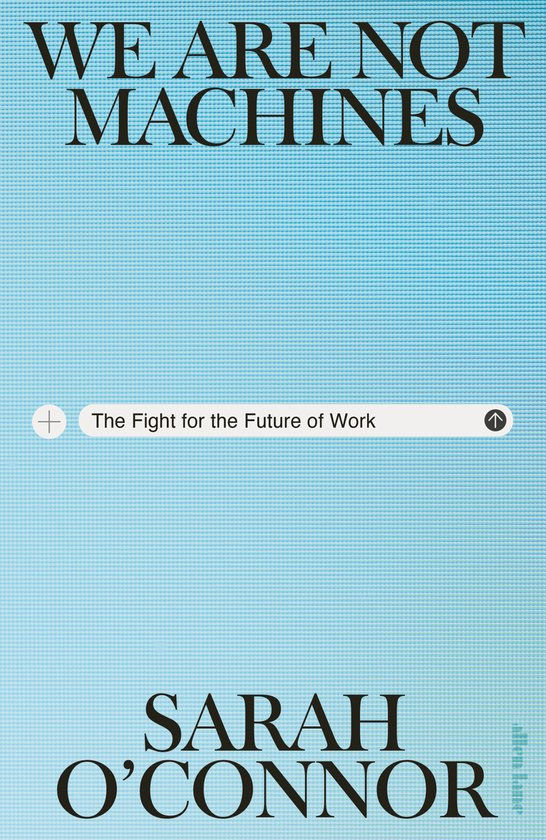 Will you lose your job to AI? Wrong question, says Sarah O'Connor, the Financial Times's work columnist. The real risk is not that we make machines in our image, but that we quietly remake ourselves in theirs. She travelled the world — from subtitle translators tidying up AI output to Swedish miners and care workers in the Netherlands — and shows that what is at stake is not the quantity of work but its quality. Her conclusion is both hopeful and combative: the outcome is not predetermined, but must be fought for by all of us. In The Guardian, Heather Stewart noted that we may be reading and thinking less as we lean on technological shortcuts. Leiderschap, governance en de moed om het anders te doen
 With The Lean Startup, Eric Ries wrote Silicon Valley's bible; now he asks the harder question: not how to build a great company, but how to keep it that way. His diagnosis is structural, not moral: it is precisely the 'best practices' — quarterly reporting, standard governance, the chase for shareholder value — that slowly squeeze the life out of principled firms. Drawing on companies such as Costco, John Lewis and Patagonia, he argues for 'mission primacy' and governance structures that protect a company's purpose from the gravity of the short term. Essential reading for anyone wondering why good companies lose their soul — and what a supervisory board can do about it. Thinkers50 placed it on its Best New Management Books list for 2026. The Common Good Economy: A New Compass — Mariana Mazzucato (Allen Lane)  From the economist who put the 'entrepreneurial state' on the map comes an ambitious argument: rebuild our economy around the common good rather than patching up markets after the fact. Mariana Mazzucato offers a 'compass' with five pillars — from embedding purpose to transparency and shared value creation — illustrated with concrete examples, from governing water to reforming procurement and finance. This is economic reform rooted in political change; you needn't agree with it to admire the ambition. The Guardian reviewed it pointedly, asking how Labour might really turn things around. Surviving Chaos: Geopolitics When the Rules Fail — Mark Leonard (Polity)  The rules-based world order is collapsing — Trump blowing up politics, Xi the economy, Putin the map of Europe — and what comes next? 'Un-order', says Mark Leonard, director of the European Council on Foreign Relations. He sees a new divide: between 'architects' who want to build a perfect system (the US, Europe) and 'artisans' who constantly adapt to changing circumstances (China). His advice to the West: stop defending yesterday's world and learn to improvise. A sharp, sometimes sobering book, discussed by Foreign Policy. Braver New World: The Countries Daring to Do Things Others Won't — John Kampfner (Atlantic)  While Western democracies seem paralysed by fear, journalist John Kampfner went looking for the places where things actually work. He visited ten countries with nerve: Finnish schools preparing children for uncertainty, Vienna's social-housing model where sixty per cent of residents live without stigma, Taiwanese healthcare that achieves sky-high satisfaction at a fraction of the cost, Costa Rica which tripled its economy while doubling its forest cover. Not utopias, but proof that hard problems are solvable — and that the real innovators are often the countries with their backs against the wall. The Observer called it engaging and informative, a plea not to lose hope; the Financial Times found it rattlingly readable and inspiring.
Family, dynasty and succession |
 One in five American adults has money with Fidelity, yet the family behind it — the publicity-shy Johnsons — remains an enigma. WSJ journalist Justin Baer tells the family epic: from its founding in 1946 to the rise of star investor Peter Lynch, and above all the battles behind closed doors over succession. The high point: how Ned Johnson initially passed over his daughter Abigail, who threatened to leave and even tried to push him out — only to become, after a reconciliation, an effective CEO. Publishers Weekly called it a labyrinthine history of one of the world's most powerful financial institutions. For anyone who knows family business and succession from the inside: a rich, at times uncomfortably familiar story about power, bloodline and letting go. Lázár — Nelio Biedermann, vertaald door Jamie Bulloch (MacLehose Press)  Ask around the book world for the most exciting new novel and one name keeps coming up: Lázár. It is a sweeping, atmospheric family saga about the decline of a Hungarian aristocratic line, from the collapse of the Habsburg monarchy to the Hungarian uprising of 1956 — written by the Swiss author Nelio Biedermann, who was just twenty-one when it became an instant bestseller in German. Gothic, at times surreal, compared to Mann's Buddenbrooks and Roth's The Radetzky March; Jamie Bulloch's translation preserves the playful, fairytale-like tone. The Guardian called it 'captivating and vivid', and The New York Times called it virtuosic and audacious. A reminder that families, and their histories, shape us across the centuries — and a beautiful novel to put your phone down for.
I wish you a summer with time to read, and above all time to step away from your role, your inbox and the noise about the machine. Because the best leaders I know are not the ones with the fastest answers, but the ones who keep asking the right questions. You are warmly welcome to get in touch after the summer — or sooner, the coffee is ready — to exchange thoughts on leadership, governance or succession, or simply on which book moved you most. Warm regards, Aegeus |


Comments